How to Know What Races You Are
What's the difference between race and ethnicity?
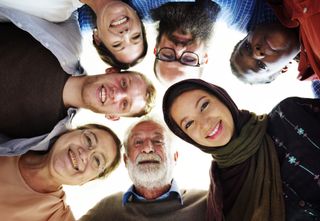
If someone asked you to describe your identity to them, where would you begin? Would it come up down to your peel color or your nationality? What about the language you speak, your religion, your cultural traditions or your family unit's ancestry?
This bewildering question frequently pushes people to separate their identities into ii parts: race versus ethnicity. But what exercise these 2 terms actually mean, and what'southward the divergence between race and ethnicity in the beginning place?
These words are often used interchangeably, only technically, they're defined as carve up things. "'Race' and 'ethnicity' have been and continue to be used as ways to describe human diverseness," said Nina Jablonski, an anthropologist and palaeobiologist at The Pennsylvania State University, who is known for her research into the evolution of human skin color. "Race is understood by most people as a mixture of physical, behavioral and cultural attributes. Ethnicity recognizes differences between people by and large on the basis of language and shared civilization."
Related: Why did some people become white?
In other words, race is oftentimes perceived as something that's inherent in our biology, and therefore inherited beyond generations. Ethnicity, on the other hand, is typically understood as something we acquire, or self-ascribe, based on factors like where we alive or the civilisation we share with others.
But simply as shortly as we've outlined these definitions, we're going to dismantle the very foundations on which they're built. That's because the question of race versus ethnicity really exposes major and persistent flaws in how nosotros ascertain these two traits, flaws that — especially when information technology comes to race — have given them an outsized social bear on on human being history.
The basis of "races"
The idea of "race" originated from anthropologists and philosophers in the 18th century, who used geographical location and phenotypic traits like skin color to place people into unlike racial groupings. That not only formed the notion that there are split up racial "types" only also fueled the idea that these differences had a biological ground.
That flawed principle laid the groundwork for the belief that some races were superior to others — creating global power imbalances that benefited white Europeans over other groups, in the form of the slave trade and colonialism. "We can't understand race and racism outside of the context of history, and more than importantly economics. Considering the commuter of the triangular merchandise [which included slavery] was capitalism, and the aggregating of wealth," said Jayne O. Ifekwunigwe, a medical anthropologist at the Center on Genomics, Race, Identity, Divergence (Grid) at the Social Science Research Institute (SSRI), Duke University. She is likewise the associate director of engagement for the Center on Truth, Racial Healing & Transformation (TRHT) at Duke. The center is role of a motility across the United States whose members lead events and discussions with the public to challenge historic and present-day racism.
The effects of this history prevail today — even in electric current definitions of race, where there's still an underlying assumption that traits like peel color or pilus texture have biological, genetic underpinnings that are completely unique to different racial groups. However, the scientific ground for that premise only isn't there.
"If you take a grouping of ane,000 people from the recognized 'races' of modern people, you will find a lot of variation inside each group," Jablonski told Live Science. But, she explained, "the amount of genetic variation within any of these groups is greater than the average divergence between any two [racial] groups." What'due south more than, "there are no genes that are unique to whatsoever particular 'race,'" she said.
Related: What are genes?
In other words, if y'all compare the genomes of people from different parts of the world, at that place are no genetic variants that occur in all members of i racial group but not in another. This conclusion has been reached in many dissimilar studies. Europeans and Asians, for instance, share almost the same set of genetic variations. As Jablonski described earlier, the racial groupings we have invented are actually genetically more similar to each other than they are unlike — meaning there'due south no way to definitively separate people into races according to their biological science.
Jablonski's own work on skin color demonstrates this. "Our research has revealed that the aforementioned or like skin colors — both light and dark — have evolved multiple times under similar solar conditions in our history," she said. "A classification of people based on skin color would yield an interesting group of people based on the exposure of the ancestors to similar levels of solar radiation. In other words, information technology would be nonsense." What she means is that equally a tool for putting people into singled-out racial categories, peel color — which evolved along a spectrum — encompasses and so much variation within different skin color "groupings" that it's basically useless.
It's truthful that nosotros practise routinely place each other'southward race every bit "black," "white" or "Asian," based on visual cues. Only crucially, those are values that humans have chosen to ascribe to each other or themselves. The problem occurs when we conflate this social habit with scientific truth — because there is cypher in individuals' genomes that could be used to split up them along such clear racial lines.
In short, variations in human appearance don't equate to genetic difference. "Races were created by naturalists and philosophers of the 18th century. They are not naturally occurring groups," Jablonski emphasized.
Where ethnicity comes in
This also exposes the major distinction between race and ethnicity: While race is ascribed to individuals on the ground of physical traits, ethnicity is more ofttimes chosen by the individual. And, because it encompasses everything from linguistic communication, to nationality, civilization and organized religion, it tin can enable people to accept on several identities. Someone might choose to place themselves as Asian American, British Somali or an Ashkenazi Jew, for instance, cartoon on different aspects of their ascribed racial identity, culture, ancestry and religion.
Ethnicity has been used to oppress dissimilar groups, as occurred during the Holocaust, or within interethnic conflict of the Rwandan genocide, where ethnicity was used to justify mass killings. Yet, ethnicity tin can as well be a boon for people who feel like they're siloed into one racial grouping or some other, because it offers a degree of agency, Ifekwunigwe said. "That'south where this ethnicity question becomes really interesting, because it does provide people with access to multiplicity," she said. (That said, those multiple identities can too be difficult for people to claim, such as in the example of multiraciality, which is frequently not officially recognized.)
Related: What happened during the Holocaust?
Ethnicity and race are as well irrevocably intertwined — not only because someone'south ascribed race can be part of their chosen ethnicity simply as well considering of other social factors. "If yous have a minority position [in social club], mostly, you lot're racialized before yous're allowed access to your indigenous identity," Ifekwunigwe said. "That'due south what happens when a lot of African immigrants come to the United States and all of a sudden realize that while in their home countries, they were Senegalese or Kenyan or Nigerian, they come to the U.S. — and they're black." Fifty-fifty with a called ethnicity, "race is always lurking in the background," she said.
These kinds of issues explain why at that place's a growing button to recognize race, like ethnicity, as a cultural and social construct — something that's a man invention, not an objective reality.
Yet in reality, information technology's non quite and then elementary.
Race and ethnicity may be largely abstract concepts, only that doesn't override their very genuine, real-world influence. These constructs wield "immense power in terms of how societies work," said Ifekwunigwe. Defining people by race, particularly, is ingrained in the mode that societies are structured, how they function and how they understand their citizens. Consider the fact that the U.S. Census Agency officially recognizes five distinct racial groups.
The legacy of racial categories has as well shaped society in means that have resulted in vastly different socioeconomic realities for different groups. That's reflected, for instance, in higher levels of poverty for minority groups, poorer admission to education and wellness intendance, and greater exposure to crime, environmental injustices and other social ills. What's more than, race is still used by some equally the motivation for continued discrimination against other groups that are deemed to be "inferior."
"It'southward non simply that we have constructed these [racial] categories; nosotros accept constructed these categories hierarchically," Ifekwunigwe said. "Agreement that race is a social construct is merely the kickoff. It continues to determine people's admission to opportunity, privilege and too livelihood in many instances, if we look at health outcomes," she said. One tangible example of health disparity comes from the U.s., where data shows that African American women are more than twice as likely to dice in childbirth compared with white women.
Perceptions of race fifty-fifty inform the manner we construct our ain identities — though this isn't ever a negative thing. A sense of racial identity in minority groups can foster pride, mutual support and awareness. Fifty-fifty politically, using race to gauge levels of inequality across a population can be informative, helping to determine which groups need more than support, because of the socioeconomic situation they're in. As the U.S. Census Bureau website explains, having data almost people'south cocky-reported race "is critical in making policy decisions, particularly for ceremonious rights."
All this paints a complex moving picture, which might leave us pondering how we should view the idea of race and ethnicity: Should nosotros celebrate them, shun them or feel indifferent? There are no easy answers. But one thing is clear: While both are portrayed as a way to sympathize human diversity, in reality they also wield ability as agents of division that don't reflect any scientific truths.
What the science does show us is that across all the categories we humans construct for ourselves, we share more in common than we don't. The real challenge for the future will be to see that, instead of our "differences" solitary.
- How have humans inverse in the past 100 years?
- The science of race: Why Rachel Dolezal tin can't choose to exist blackness
- Why haven't all primates evolved into humans?
Originally published on Live Scientific discipline .
Source: https://www.livescience.com/difference-between-race-ethnicity.html
0 Response to "How to Know What Races You Are"
Post a Comment