Book Review Reading the Old Testament Lawrence Boadt
Reading the Quondam Testament past Lawrence Boadt and Historical Criticism

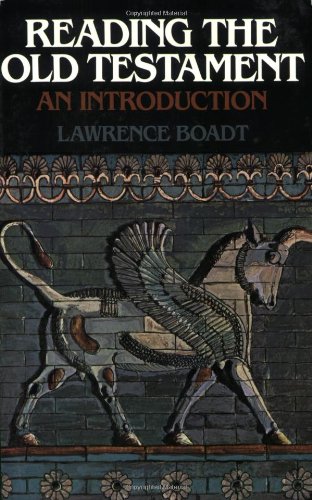 Reading the Erstwhile Testament: An Introduction , by Lawrence Boadt (Paulist Press, 1984).
This piece of work was recently revised and updated but I have the older, original version of this work which has been quite popular in some circles. While it's not of much value for a book review, it's of keen value for evaluating critical approaches to the OT. This volume was published in 1984 and in some ways shows its datedness. For case, his chapter on the psalms has cypher about the shape and shaping discussions because Wilson didn't publish his monograph until 1985. As a textbook, the revised and updated version is convincingly helpful, but I want to focus here on Boadt'south approach to the OT and what we can learn from it.
I would allocate this work as offset Christian, second critical, and tertiary Catholic. While I'k not Cosmic, the benefit of a Catholic textbook on the OT is that information technology includes give-and-take of the other seven Greek intertestamental works that are important for NT backgrounds (and, of course, for seeing to where the stream(due south) of the OT menstruum). Moreoever, Boadt enlists Pope Pius XII's support for a critical approach to the OT based on hisDivino Afflante Spiritu(1943). More recently in 1989, Joseph Ratzinger (Bridegroom XVI) chosen for a "criticism of criticism." The failure to produce objective and bodacious results does non call for rejecting the method, but recognizing its limits and purifying it. Religious evolution is improvable, and Christian history shows u.s.a. that the greatest thinkers were oft followed by lesser thinkers, non the reverse. He suggests that exegetical method is a matter of philosophical debate, and the mode forrard must involve the great search for a philosophical foundation in our modern fourth dimension. He suggests there should exist no dualistic split of event and word, and the principle of aperture should be replaced by the analogy of Scripture. The tools of exegesis should still be used, but with a proper understanding of philosophical assumptions that can affect them. Also, the full range of historical exegesis should be considered, not only the final couple centuries. This papal support for critical interpretation (specifically from Pius XII, but Ratzinger is in line with the spirit of critical interpretation also) undergirds Boadt's methodology in this work.
His disquisitional approach is intriguing for me since I like to see what aspects of historical criticism and what tools from other disciplines may exist integrated into a hermeneutical framework that respects the texts and avoids philosophical problems (equally Ratzinger mentioned). The critical elements of this volume are typical: Deuteronomy was written during the exile, prophecy isex eventu, Wellhausen'south DH still stands, Genesis 1-11 is myth, State of israel borrowed many religious ideas from her neighbors, etc. Boadt believes that, although the Bible is now joined together as i canon, "a series student of the Onetime Testament must get behind the present unity to detect how Israel grew and changed and deepened its faith" (81). He advocates using source criticism, form criticism, and tradition historical criticism. Hither he misses a few other tools he could accept included such equally sociological methods and literary methods, just not all were in total bloom yet.
How does he salvage whatever Christian value to a fragmented, syncretistic, and varied Old Testament? The fact that he does so is the reason I say this piece of work is commencement a Christian introduction to the OT, and secondly a critical introduction. He values the OT for Christian faith and believes information technology nonetheless speaks to us today. Here I find his try to take critical dogmas and translate them into pious devotional points to fall apartment. If Deuteronomy was written in the exile, it's quite difficult for me to excogitate of its usefulness for Christians (or anyone). Boadt makes the typical argument that "the authors manage to become their message across past the very effective ways of putting the warnings in the rima oris of the peachy founder himself. This was a very common method of writing in the ancient world. It was not an endeavor to deceive, only to link a writer'south religious teaching to its real, and much more ancient source of authorization" (347).
At that place are three problems with this claim. First, the premise that Deuteronomy was written past someone other than the author(s) of the rest of the Pentateuch shows us that at that place is a difference in theology, linguistic communication, teaching, and ideas between Deuteronomy and the other books of Moses. So for these exilic authors to claim Moses' voice creates a stark opposition to more than ancient Mosaic tradition; they have opposed their ain tradition, which doesn't quite motion me to pious devotion. 2nd, we accept no evidence that these hypothetical exilic authors claimed Moses's voice in skillful faith. In fact, many scholars run into this as a political ability play to go the Jewish exiles under their sway. There'south no evidence either way, so how can we claim it wasn't an try to deceive? Information technology's an unprovable claim with no evidence. Third, a truthful Christian method would take into consideration (at least) that Jesus believed Moses wrote Deuteronomy (or parts of information technology), and that Jewish tradition held the same. Here there is a way out: Jesus either pretended Moses wrote information technology (even though he knew amend), or his divine noesis that he exhibited in the realm of peoples' thoughts, deportment, locations, and plots did not work in the realm of biblical authorship. Merely are these really honest, academic conclusions? I don't think and so; they seem to me to existadvertizement hocsuppositions to get you out of a corner you've backed yourself into. There's no evidence for either decision (that Jesus pretended non to know about JEPD or that Jesus was ignorant), and they are both ad hoccreations to solve a major hermeneutical and theological problem.
Another problems with Boadt'south critical method should be noted. He follows Wellhausen quite closely and does not mention many major criticisms of his piece of work, while nowadays the Elohistic source is entirely questioned and alternating paradigms have been proposed. Boadt omits other major Pentateuchal compositional theories. Another problem common for the disquisitional method is its incredibly small pool of data. Boadt follows the consensus of his time that Ps 29 is borrowed from Ugaritic mythology, with the ideas applied to Yahweh (222). More recent scholarship has been far more than cautious about concluding this, as Peter Craigie notes in his Ugarit and the Old Testament, along with giving several other examples of this type of academic overstep. The problem here with both of these examples (and they could be multiplied) is that these examples are used to form the conclusion that Moses did non write the Pentateuch and that Israel borrowed ideas, language, and theology from her neighbors. Both the testify is piddling, and information technology can be interpreted in many unlike means. Here is the downfall of the "assured results of historical criticism." What is assured in one historic period is no longer assured in another.
I could praise this textbook for many positive elements, but I wanted to focus on its use of the critical method since information technology is an important issue for Christian religion. Indeed, an edited work, Evangelical Faith and the Challenge of Historical Criticism, recently tried to square many historical-critical dogmas with Evangelical (or orthodox) theology, and I found again some major hermeneutical problems in this attempt. The more than I consider the two approaches to Scripture, the more I find that they are ultimately mismatched puzzle pieces that simply don't fit together. But the question will always be one to pursue and consider.
Observe it here on Amazon.


Source: http://exegeticaltools.com/2015/06/11/reading-the-old-testament-by-lawrence-boadt-and-historical-criticism/
0 Response to "Book Review Reading the Old Testament Lawrence Boadt"
Post a Comment